

Agents Can't Steal Ideas
- A S H

- Jun 24, 2024
- 9 min read

A literary agent nuked her career by asking people to write a novel for her.
"Just read a query that was essentially THE ROAD meets DELIVERANCE (#YA) and now I want someone to write this for me, please?"

This image exists because @JayMoneWrites had the sense to screen cap this before posting it up on X--formerly Twitter. The original post is now gone. Hilary Harwell, the agent, was terminated from her position. Her account is now deleted. Despite everything else, I hope that Hilary Harwell has an emotional support network. Outside of the world of writing and publishing most people don't even know who literary agents are, but inside is a very different story. They can make a career. One like from their account can change a writer's life. A single email can turn a writer into an author. Their power as a gatekeeper affords them incredible influence within that space.
When the first responding authors were pointing out that Hilary Harwell was proposing idea theft with a starry eyes emoji, they did so not with vitriol and outrage, but an appeal to sense. "with respect do you not see how it's actually kind of insidious for an agent with industry influence to reject a querying writer with no power and then try to get someone ELSE to write THEIR concept but "better" just because they didn't use those specific comps?" asked @jamiedamato.
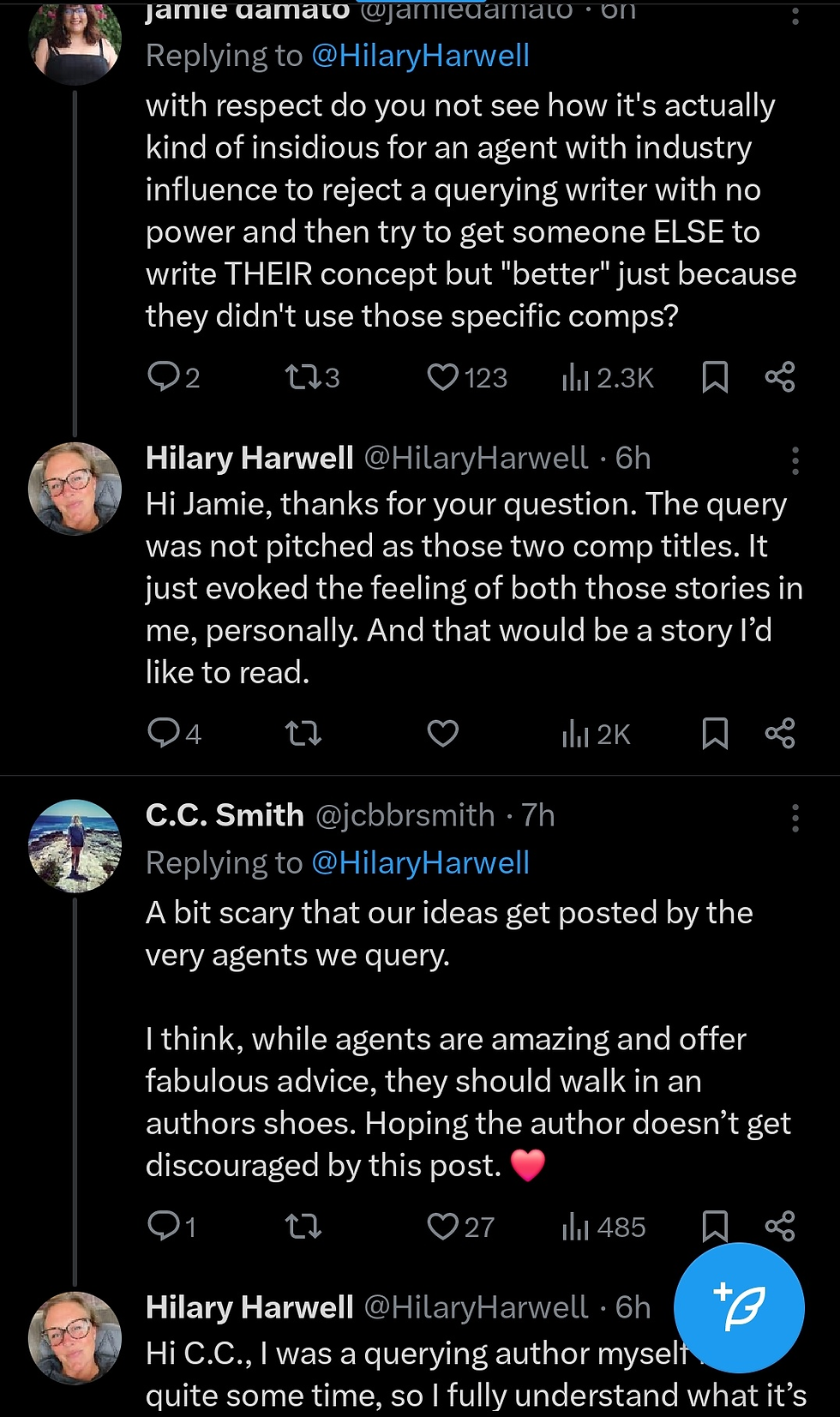
I have nothing against Jamie Damato's response. As they pointed out, writers have no power in this situation. Jamie's response reads like an employee desperately trying to course correct a terrible decision made by their boss. Jamie is repped by a different agent, but they likely know that they can't speak to a literary agent with anything but deference.
This imbalance of power is at the heart of all interactions between agent and writer. For some, they're able to keep their head low and agree to whatever the agent says. Others crack under this pressure. Some go so far as to send manuscripts to agents homes, bother them in restrooms, and send harassing letters. A few have gone so far as to lie about their ethnicity in a desperate attempt to get agents to notice them. (See the drama of Kim Chi.)
While their behaviors are inexcusable, I do think that these outraged outliers speak to the desperation of the modern writer.
Literary agents shift through thousands, some of them go through tens of thousands of query letters a year. The so-called slush pile is overflowing with writers who have put years into an endeavor that statistically will amount to nothing. To counteract this there are special pitch parties where agents use specific hashtags to look for a book they're actually interested in.
Pitching to agents has grown into an industry all of its own. People are selling their time to help writers refine their pitch. There are conventions where writers spend hundreds, if not over a thousand dollars, for the privilege of having an agent look at your pitch and tell you what's wrong with it.
I don't think it's uncontroversial to say that the process of pitching is detrimental to the mental health and well being of the writer. Maybe for some the writer is able to work on pitches day in and day out no matter how many rejections they get, but I've seen what it does to other writers and I went through that process myself. I was degrading, dehumanizing, and demoralizing.
Seeing a post where an agent asks for writers to make a specific book, for them, I don't immediately think, "How conceited." No, I understand why a writer would see a post like that and think, "I could do that. These comps aren't that far from my tastes anyway. Three weeks of hard work and I could get the novel done. Two weeks for a rush line edit and I could have something for this in a few months, maybe even two!"
Because if the writer knows that one agent will actually READ their pitch, query, and book, then they might have a chance at getting representation. That's the thing about pitching, there are so many submissions out there that many queries only ever get a template response.
I want to imagine what it's like from the other side.
Literary agents look through dozens of queries an hour. They process hundreds of queries a week. Maybe at first they try to give each writer a chance, but at some point it's going to be easier to think about what you want and not what they're offering. With each new query letter an agent can look to the comps and decide in seconds if this is going to be worth their time. Online pitches help this process. If they're looking for something like Gideon the Ninth, they can put that into the search and ignore every book that doesn't have that title. It becomes a roulette wheel of writers, each scroll down giving more options until their eyes start to hurt and they decide to drop a post asking for what they want.
I know for a fact that this isn't how every agent operates. Agents with decades of experience have a vague MSWL (manuscript wish list: basically what they're looking for) that more or less boils down to "If I like their pages, I'll give it a shot." The problem is that most of those agents already have clients. Their windows of accepting submissions are small and sometimes non existent. Regardless, they exist. I've seen them. I've read and listened to agents say that it's about the pages and not the pitch.
The thing is humans aren't always the best at selecting ideal candidates. When there are more options we can get fickle and picky. Some dating shows have experts that the candidates interact with. The worst clients are always the ones with very specific wants and hard NOs. Dating experts will frequently try to encourage them to open their minds and look at their dates as is, but people aren't always able to do this. They think, there's a million people out there for me, why should I have to compromise?
There's another instance of human selection that falls into this kind of practice and that's porn. People scroll through video after video and can even search for a particular kink or a particular performer. They can choose from everything and so they can be as picky as they want. They never have to fully compromise their expectations because there are always more videos.
Except, this practice isn't limited to porn. Instagram, Twitch, Tik Tok, and even Twitter all fall into this habit of selecting people by the users tastes. This way of thinking has become a part of our world. Don't interact with the person in front of you, text the person you want. Don't wait for a text conversation, watch your favorite personality gab on and on about exactly what you like.
Society is dehumanizing humans and publishing isn't immune to this shift. Agents aren't talking to their applicants one at a time, they are endlessly sifting through them like trying to find a good website in 1997. In time maybe this problem will be "fixed" and all writers can submit their queries to something like Tik Tok, so the agent can swipe from one query to the next.
It has never been harder to get an agent and even if you do, there is no guarantee that your book will become a best seller. There isn't even a guarantee that you can quit your day job.
All of this drama is about publishing, but more importantly it's about literary agents. They are the gatekeepers that writers seek to impress, but once that gate is passed, it isn't heaven on the other side. Writers still have to promote. They still have to be a brand. They still have to edit, and rewrite, and make their story the best that it can be.
I don't know if all agents are like this, but I keep hearing stories about agented authors having to do all of the work that an independent writer does. All of it. They have to promote their book, they have to edit their pages, and if they want it to be perfect they have to pay for a structure editor to see why it doesn't work and then take the time to rewrite it themselves. Again, I don't know if some writers get a team of people helping them with their book, but from what I've seen, they don't. The book is expected to be perfect as is and only gets a simple line edit before going off to the printers.
Somewhere in this drama is the story of the writer who queried Hilary Harwell with the original idea. I don't know who this person is. I haven't found anyone talking about them. Maybe this writers didn't see Hilary Harwell's post. Maybe they blocked the author before stealing the idea, but I doubt it.
Plagiarists usually see themselves as above their victims. Given the flippant tone in Harwell's responses, she likely didn't even think she was stealing from the writer at all. In her mind, she was looking for comps, comps that no modern writer would ever list (writers are expected to only reference newer media) but comps nonetheless. She probably thought that Twitter was over reacting right up until the moment that she lost her job.
In all likelihood, the writer who queried Hilary Harwell saw their post talking about how their pages weren't good enough. They didn't get a revise and resubmit request, only an indirect declaration that their skills were bad. Likely the tweet came before their form rejection letter was even emailed. I can't imagine what seeing that post must've been like, but I hope the writer went back on later to see that she lost her job.
But there's another story. The story of 22 authors wronged by Hilary Harwell's decision and the chaos that's likely happening at KT Literary.
Their official statement reads: "We at KT Literary have decided to part ways with an agent whose recent public statements directly contradict our values and the trust we work to build with our clients. We are reaching out to affected clients to discuss their representation options and ensure continued support. Thank you for your patience and understanding."
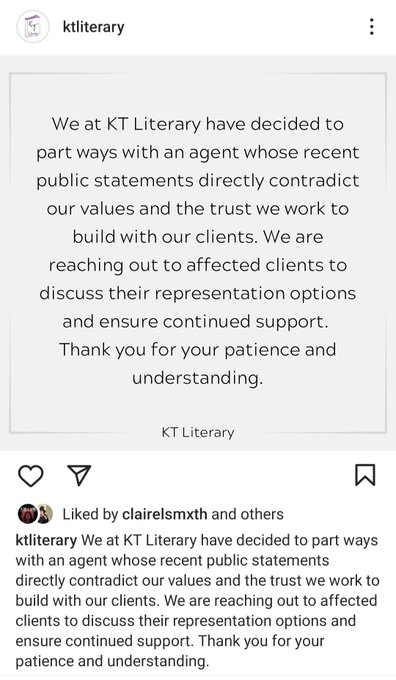
This statement was released via Instagram as even the literary agency sees little value in maintaining a presence on Twitter.
At another time, I might've seen the phrase "an agent whose recent public statements directly contradict our values" as cowardly, evasive, and lacking responsibility, but that would've been a short sighted response. This isn't only about the reputation of KT Literary. KT Literary has clients to consider.
Hilary Harwell was representing 22 authors at the time of her termination. She might've also had a client or two that she was in talks of securing. Dragging Hilary Harwell may have had a negative impact on the writers she represented. What's to become of these clients?
Looking through their socials, I don't find giants of social media luxuriating in their wealth and status. I find what looks to be dead accounts. I see accounts on Instagram and X with less than a thousand followers and posts that aren't connected to any modern book deals, public appearances, or even recent activity. One even has a retweeted thread with 500 likes, 500 retweets, no comments, and I promise to do something with cryptocurrency.
While some accounts have a few thousand followers, they don't even have the numbers that I walked away from. Two of Hilary Harwell's clients appear to be active on X, but they're not saying anything about losing representation. PR being what it is, they might never release a statement about losing their literary agent.
For me, the bigger take away is the fact that these represented authors aren't swimming in money. Readers are still fickle and they don't immediately flock to books that have been put out by a big name. It is hard to find people who habitually read books and once you do, it's harder still to find someone that is into the same genre, let alone the same authors. This tends to push readers to explore what is popular so they can be in more conversations. These trends in reading don't only hurt indie authors. This is a difficult industry.
The Friday before this drama happened I finished a line edit on my upcoming book, "Lovelife of a Deathdealer." I was excited to be ready for the next step, but I wasn't sure what to do with it. I could wait to buy more ISBNs, circulate it through Kindle Unlimited, or try to query it. Seeing all this drama, I'm reminded of how dehumanizing the entire process can be. It will take me a lot of effort, cause me a lot of drama, and in the end, statistically I will get nothing but stress for all of my effort.
The thing that really irks me about the publishing process is that I know there are good agents out there. I know there are people at those offices that look at a manuscript and think "they're not ready" and move on. There isn't any judgment, it's a simple measure of the writer's skill added onto the weight of an idea. I don't know if I can get a manuscript onto their desk. I don't even know if they'd even consider office romance with a twist on supernatural elements. All I know is that the querying process is grueling, thankless, and dangerous.
The last time I pushed forward and tried to write and network and edit and publish and query it broke me. Landing an agent doesn't change my life. It doesn't make me a better writer. I don't think it's worth the risk. If you're a querying author, please let me know why you're still doing this. I know there are a lot of reasons to try, but please don't make it validation. You're a good writer if your readers like your book. That's it. Good luck to everyone.



Comments